How Much Does Teeth Whitening Cost in the UK in 2026? Laser, Trays and What Works
Professional whitening in the UK typically costs £300 to 700 in the chair, £200 to 450 with take-home trays and £400 to 750 combined; the NHS and dental insurance do not pay. At our clinic it is 150 to 400 EUR. UK law caps dentist gels at 6% hydrogen peroxide and bans whitening by non-dental staff; the gel, not the light, does the work. Crowns and veneers do not whiten. A trip just for whitening costs more than doing it at home; it makes sense only on a holiday you are taking anyway or alongside crowns or veneers.
Professional teeth whitening in the UK typically costs £300 to 700 for an in-surgery (power or "laser") session and £200 to 450 for dentist-made take-home trays, with combined courses usually £400 to 750; the NHS does not offer whitening at all. At our clinic in Fethiye whitening costs 150 to 400 EUR (roughly £130 to 350). That difference is real, but it is smaller than the cost of a flight and a hotel, so whitening on its own is almost never a reason to travel. This guide explains what each method costs at home, what the law allows, what actually works, who should not whiten at all, and the one situation where doing it in Turkey makes sense.
Teeth whitening cost in the UK at a glance
Method
Who does it
Time
Typical UK price
At our clinic in Fethiye
In-surgery whitening (power, LED or "laser")
Dentist, at the chair
One visit of about 60 to 90 minutes
Typically £300 to 700; premium branded systems in central London can approach £1,000
Within 150 to 400 EUR
Take-home trays
Dentist makes custom trays, you apply the gel at home
2 to 4 weeks of daily or overnight wear
Typically £200 to 450
Within 150 to 400 EUR
Combined (in-surgery plus trays)
Dentist, then you at home
One visit plus 1 to 3 weeks of trays
Typically £400 to 750
Upper end of 150 to 400 EUR
Over-the-counter strips, pens, LED kits
You
Varies
Typically £10 to 60
Not offered
Beauty salon or kiosk whitening
Not legal in the UK unless carried out by a registered dental professional
N/A
N/A
Not offered
NHS
Not available; whitening is cosmetic
N/A
N/A
N/A
UK prices vary more by postcode than by method. Central London practices sit at the top of these ranges, and many practices outside the South East quote £250 to 450 for trays and £350 to 550 for a chair-side session. Ask whether the quote includes the examination, the scale and polish beforehand and a review appointment, because those can add £50 to 150.
The methods, and what they really do
In-surgery whitening (power, LED or "laser")
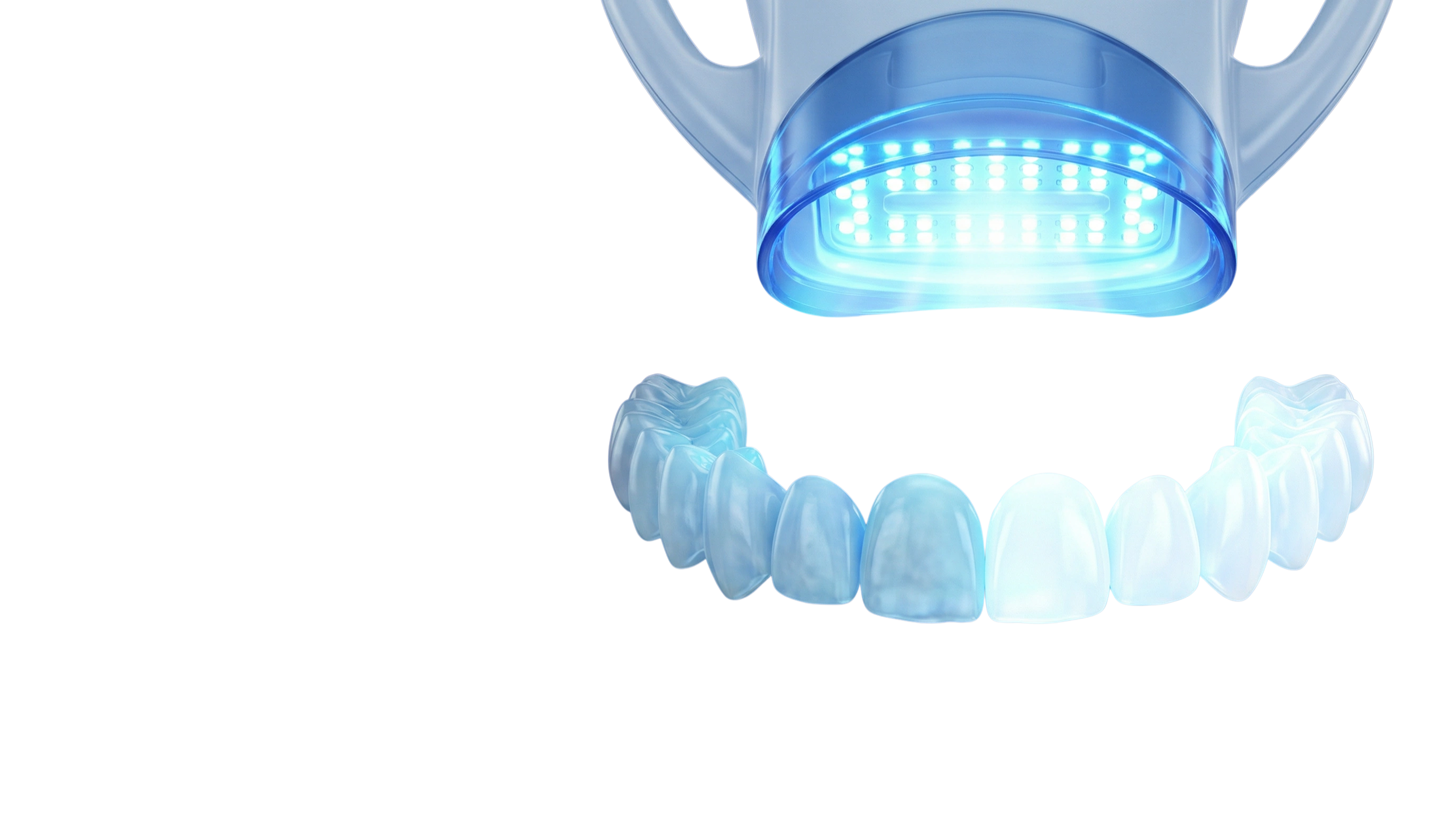
The dentist protects the gums with a barrier, applies a hydrogen peroxide gel and usually shines an LED or laser light on it, in several cycles of around 15 minutes. You walk out with a visibly lighter shade the same day. Two points are worth knowing. First, the gel does the whitening; the light speeds things up a little and makes the session feel more technical, and part of the immediate effect is the tooth drying out during the session, which settles back over the following week or two. Second, in the UK the gel a dentist may use is capped at 6% hydrogen peroxide (more on the law below), which is why many UK dentists prefer trays or a combination rather than a single chair-side session.
Take-home trays from your dentist
The dentist scans or takes impressions of your teeth, makes thin custom trays and supplies a whitening gel, usually carbamide peroxide at a strength that releases up to 6% hydrogen peroxide. You wear the trays overnight or for a few hours a day for two to four weeks. It is slower and asks for discipline, but for many people it gives the most even and stable result, and the trays can be kept for top-ups for years. Per shade gained, it is usually the best value.
Combined treatment
An in-surgery session followed by one to three weeks of trays is the most predictable route for teeth that are quite yellow, and it is what most branded "premium" whitening systems in the UK are. You pay for both, so it sits at the top of the price range.
Over-the-counter strips, pens and LED kits
Products sold in shops and online may contain no more than 0.1% hydrogen peroxide. Many use alternatives such as PAP or simply polish off surface stain. They can freshen a smile that is stained by coffee or tea, but they rarely change the underlying shade much. The real risk is not the strips themselves; it is illegal products bought online that contain far stronger peroxide or chlorine dioxide and burn the gums or etch the enamel.
Single dark tooth after a root canal
A tooth that has turned grey after a root canal or an old knock does not respond to normal whitening. It needs internal bleaching, where the gel is placed inside the tooth over one to three visits, or sometimes a veneer or crown. This is a different treatment and is quoted separately.
What the law allows in the UK
The rules come from the Cosmetic Products Regulations (amended in 2012 and kept after Brexit) and from the General Dental Council's position on who may whiten:
Up to 0.1% hydrogen peroxide: may be sold over the counter.
Over 0.1% and up to 6%: may only be supplied to dentists. The first application must be done by a dentist or under their direct supervision after an examination; the rest of the course can then be carried out by you at home with the trays.
Over 6%: not permitted for whitening in the UK.
Under 18: no whitening with peroxide above 0.1%, except to treat disease.
Who may whiten: only registered dental professionals (dentists, and dental hygienists and therapists on a dentist's prescription). Beauty salons, mobile "whitening technicians" and shopping-centre kiosks offering whitening are acting illegally, whatever product they say they use.
So "laser whitening" in a UK practice uses the same maximum-strength gel as trays. A higher price does not buy a stronger product, only chair time, the light and the practice's overheads.
What insurance and the NHS cover: nothing
Whitening is cosmetic. The NHS does not provide it in any band, and dental insurance policies and monthly practice plans normally exclude it, although some plans give members a discount. What the NHS does cover is the sensible first step: a Band 1 check-up with a scale and polish, £27.90 from April 2026 in England. Removing tartar and surface stain first often makes teeth look a shade lighter on its own and shows whether whitening is needed at all. Our guide to NHS charges versus private and Turkey sets out the current bands.
How long results last, and what top-ups cost
Professional whitening typically lasts one to three years before the shade drifts back noticeably. It lasts longer if you do not smoke, keep coffee, tea and red wine moderate, and have a hygiene visit every six months. Top-ups are where trays earn their keep: a few nights with fresh gel in your existing trays, bought from your dentist for typically tens of pounds rather than hundreds, restores most of the result. Without trays, a top-up usually means paying for another chair-side session. Sensitivity for a few days after whitening is common and settles; a desensitising toothpaste for two weeks beforehand helps.
Who should not whiten, or should not expect much
People with crowns, veneers, bridges or white fillings on the front teeth. Ceramic and composite do not whiten. After whitening, the natural teeth will be lighter and the restorations will not, so they may need replacing to match. Plan this before you start, not after.
Untreated decay, leaking fillings or gum disease. These are treated first; peroxide on an open cavity or inflamed gums hurts and can damage the tooth. See our gum disease guide.
Exposed roots and receding gums. Root surfaces do not whiten and are often sensitive.
Grey or banded staining from tetracycline antibiotics in childhood, and marked fluorosis. These respond slowly and unevenly; bonding or veneers may be the honest answer, which our whitening vs veneers comparison explains.
Under 18, pregnant or breastfeeding. Whitening is postponed.
Very thin enamel or heavy wear, where the darker dentine shows through; whitening can only do so much.
Yellow, age-related or coffee and tea staining on healthy natural teeth responds best. If one or two edges are chipped as well, composite bonding after whitening often finishes the job; our composite bonding guide covers the costs.
Choosing a method
Healthy teeth, a few shades darker than you would like, and patience: take-home trays. Best value and easiest to maintain.
An event in a week or two: in-surgery, ideally with trays to follow so the result holds.
Quite yellow teeth and you want the most predictable result: combined.
Light coffee staining only: a scale and polish first, then decide; toothpaste and strips may be enough.
One dark tooth: internal bleaching, not general whitening.
Whitening in Turkey: when it is worth it, and when it is not
We are a clinic in Turkey, and our honest answer is that whitening alone is not a reason to book a flight. The figures below use a typical UK combined course of £600, a typical price at our clinic of about 300 EUR (roughly £260), £450 for a return flight to Dalaman plus three hotel nights, and £600 for flights plus six nights when other treatment needs a full week.
Scenario
UK, typical
Treatment at our clinic
Travel
Total in Fethiye
Difference
A trip just for whitening
£600
£260
£450 (flight and 3 nights)
£710
About £110 more. Not worth it
Whitening added to a holiday you are taking anyway
£600
£260
Already paid
£260
About £340 less
Whitening plus 4 zirconia crowns
£4,200 (£600 plus 4 × £900)
About £1,220 (300 EUR plus 4 × 275 EUR)
£600 (flight and 6 nights)
£1,820
About £2,380 less
Read the table from the bottom up. The saving in the last row comes from the crowns, not the whitening. What whitening adds there is clinical rather than financial: if crowns or veneers are planned, the natural teeth should be whitened first so the new work is matched to the lighter shade, and doing both in one plan avoids paying for replacements later. Timing matters, because bonding to freshly whitened enamel is less reliable for a short period and the shade settles over the first days, so the order and the gap are set out in the written plan. The second row is the other honest case: if you are coming to Fethiye on holiday, a one-hour appointment saves money, takes one morning, and only asks you to avoid strongly coloured food and drink for about 48 hours.
The guide to teeth whitening in Turkey describes our methods in detail: in-office whitening with LED (Zoom) or laser activation in a single session of about 45 to 60 minutes, and custom-tray whitening with clinical gel for two to four weeks at home. Treatment on site takes one to three days. Whitening does not appear in our written guarantee, because no restoration is placed and the colour will drift with diet and habits wherever it is done; the guarantee covers implants, veneers and crowns. If the reason you are looking at Turkey is that someone has suggested a full set of veneers to make healthy teeth whiter, read how to avoid Turkey teeth gone wrong first: for healthy teeth, whitening is usually the right answer and veneers are not.
How it works with us in Fethiye
Send clear photographs of your smile in daylight, and an X-ray if you have one, through the consultation form. Dr. Mustafa Besli, who has practised aesthetic dentistry for over 15 years, reviews them and you receive a written plan and price before you book anything: which method suits your teeth, whether any filling or gum treatment comes first, and which existing crowns or fillings will not change colour. Flights from UK airports land at Dalaman, about 50 minutes from the clinic, and the airport transfer is included. If the photographs show that a scale and polish at home is all you need, we will tell you that instead. Details of the treatment itself are on our teeth whitening page.

Dr. Mustafa Besli
Smile & Holiday
Dr. Mustafa Besli is the head dentist at Smile & Holiday in Fethiye, Turkey, specializing in aesthetic dentistry, smile design, and implantology with over 15 years of clinical experience.
Frequently Asked Questions
Frequently asked questions about this topic
Related Treatments
Explore treatments related to this article